Category Archives: Children

The Fierce, Rabid Giving Tree

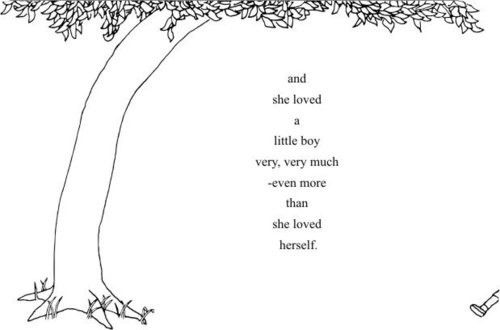
The Giving Tree

Courtesy of Shel Silverstein

Recently, a friend sent me a note in which she mentioned that “The Giving Tree” is her daughter’s current favorite book. Before reading my friend’s letter, I hadn’t thought of my favorite Shel Silverstein work in a while. Ever since, I’ve been thinking about why I love this story so much.

“Once there was a tree … and she loved a little boy.”

According to Silverstein’s website, this touching story “offers an affecting interpretation of the gift of giving and a serene acceptance of another’s capacity to love in return.” The tree loves the boy without condition, never thinking about what’s in it for her. When it seems there’s nothing left for the tree to offer the boy, still she finds more to give. It is a poignant story, and a beautiful concept.

Some people think the tree represents God. I don’t know how I never noticed it before but, to me, the story chronicles the relationship between a mother and her child.

Until now, I didn’t think too much about how mothers give their flesh and blood in the most literal sense possible. Just as the tree provides her fruit, her branches and even her trunk, women share every bit of themselves; all with the goal of helping their babies grow strong enough leave and forge their own way in the world.

My mother did this for me, and her mother for her and so on. It’s an incredible thing when you stop to think about it.

From my earliest visions for the nursery, there’s been one part of the décor that I’ve consistently imagined: a mural climbing up the wall and arching over the crib. Without really knowing why, I always pictured a tree, with or without birds, leaves or fruit, but always forming a protective canopy over where the baby will sleep.

It’s only just now occurred to me that I’ve been picturing the Giving Tree all along.

I recently came across another thought-provoking perspective on motherhood in a book called “Sister Mine” by Tawni O’Dell. According to the book’s protagonist, a mother’s love “is not warm and cuddly like a soft blanket, as it’s popularly portrayed. It’s a fierce, rabid love, like having a mad dog locked inside you all the time.”

Already, I get it — I don’t want to think of this baby ever feeling sadness or fear, loneliness or pain. And if any person threatens this baby’s safety or well being, I suspect there’s a rabid, frothing dog lurking inside me, just waiting for the moment she’s needed. (Suddenly the term, “bitch” seems so perfectly apropos.)

I guess my interpretation of motherhood falls somewhere between Silverstein’s and O’Dell’s versions, but doesn’t align perfectly with either.

I can’t wait to let this baby swing from my branches and nap in my shade, but I don’t plan to end up a felled stump, happy only when I’m serving my child. Similarly, I know I’ll ferociously protect my baby from the pain in the world, but without teaching him or her to turn a blind eye.

I want to be a Giving Tree for this baby and I hope the world will be one too. And yet, I don’t want the world to simply drop apples into his or her outstretched hand. I’d prefer to watch my child climb the world’s highest limbs and learn that the sweetest fruit is sometimes the hardest to reach.

And the tree was happy.
Listen to the Oompa-Loompas

Blueberry Baby

"I feel funny!"

Apparently, I’ve “popped.” That’s what I’m told, anyway.

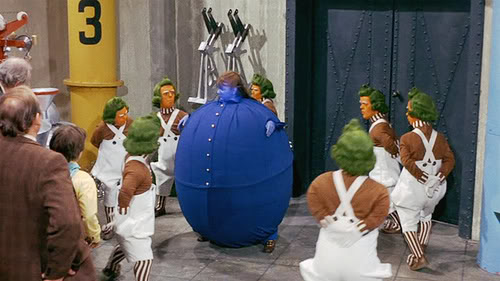
When I look in the mirror, suddenly I see Violet Beauregarde staring back, with a horde of Oompa-Loompas dancing around me in a circle.

Recent developments include:

1.     I’ve become unable to perform any activity without making a loud grunting sound, like Monica Seles delivering a game-ending slam. This happens whenever I’m getting in the car, getting out of the car, getting out of bed or trying to lift my foot.

2.     Basic activities cause me to break out in a body-drenching sweat. Like typing. Or breathing.

3.     I’ve started to walk with a distinctive pregnant-lady swagger: a lazy waddle that involves tilting the shoulders back, jutting the belly forward and moving slower than a toddler who’s just learned to walk.

All these things add up to one thing: my pregnancy has become impossible to ignore. People are now comfortable assuming my inflated girth isn’t just from an increased consumption of jelly doughnuts. As a result, I’ve been getting some pretty bizarre comments. Reference the conversation I had with one of the cooks in the cafeteria at work:

Cafeteria Guy: That thing doesn’t even look real!

Me: Huh?

CG: Looks like you got a pillow stuffed up under your shirt!

Me: Oh. Yeah, it’s definitely real.

CG: Gonna be a big baby!

Me: Well, I hope not. For my sake.

CG: I was a big baby. I was so big my mom had to have a hip replacement after giving birth to me!

What is it about pregnancy that brings out so many inappropriate comments? It’s nice when people congratulate me or ask me when I’m due (as long as they don’t assume it’s within the next 24 hours). But there are a lot of weird exchanges too — like when strangers call out, “Hey, mommy!” And can someone please tell my male co-worker to stop referring to me as “Preggers” (this is the same guy who asked me the other day if I “stopped at Denny’s for a big-ass breakfast” on my way into work)?

I’m often reminded of the scene in Juno when, referring to the very public nature of her pregnancy, the knocked up title character tells her baby daddy, “At least you don’t have to wear the evidence under your sweater.” Like Juno, I have days when I wish this big belly were one of those fake pregnancy suits forced upon unsympathetic husbands and promiscuous teenage girls, just so I can take it off for a little bit.

It’s been hard to get used to my new reflection in the mirror. Inside, I still feel like me: a friend, a daughter, a career woman, a wife. Most of the time I feel like a kid, just trying to figure it all out. I can’t get used to the idea that I’m going to be someone’s mom. That word carries a lot of weight.

Being pregnant creates more questions than answers. I feel like the most common phrase out of my mouth these days is, “I don’t know.” I don’t know if this baby is a boy or a girl. I don’t know what direction my career will head after he or she is born. I have absolutely no clue how we’ll ever choose a name. But, thankfully, this little one doesn’t give me any uncertainty about its vitality; there seems to be a party going on inside of me all day, every day (and night).

If only those Oompa-Loompas would sing me a charming little song with a helpful moral at the end.

Oompa Loompa, do-ba-dee-doo,
What do you do when your belly gets huge?
Oompa Loompa, do-ba-da-dee,
Try to relax and let it all be.

I’ll try, Oompa-Loompas. I’ll try.

What’s Inside the Diaper?

A creative, convention-free kid

The devastating consequences of letting your child make her own choices.

It turns out my husband and I are not brave pioneers.

Apparently, waiting to find out your baby’s gender until the delivery is child’s play. Waiting to find out its gender until the baby tells you what it is: now that’s hard-core.

Can we talk for a minute about the Canadian parents who refuse to reveal their baby’s gender, saying, “If you really want to get to know someone, you don’t ask what’s between their legs”?

Seriously.

To some extent, I get it. They want their child to grow up with his or her own sense of identity, unburdened by society’s judgment and expectations. Frankly, I want the same things for my child.

However, I can’t get over the irony (hypocrisy?) of the situation. In making their child’s gender a big, creepy secret, these people have created an international inquiry into what’s inside the diaper.

The couple says they’ve noticed “parents make so many choices for their children. It’s obnoxious.” These parents don’t seem to realize they’ve already made a very big choice for their children by exposing them to such complex and emotionally charged issues at such young ages.

It seems to me that, in an effort to give their child freedom of choice, this couple is actually foisting a radical viewpoint on a baby who’s blissfully unaware of what he or she “is.”

Do we really need to worry about four-month-old babies being stereotyped? While cooing over a new baby, I don’t think too many people are thinking about his or her sexuality or future choice of magazine subscriptions. When you’ve only been alive for four months, people mostly just worry about whether or not you’re able to pee in their face while your diaper’s getting changed.

When I was young, I was fortunate enough to attend the fantastic Columbus, Ohio pre-school, School For Young Children (SYC). Long before it was hip to do so, this school facilitated an open-minded and accepting environment where kids engage in self-directed, imaginative play. At SYC, if a boy chooses to spend the day in a princess dress from the collection of dress-up clothes, no one blinks an eye. Similarly, no one pulls that boy aside and asks him, “are you sure you want to be a boy? Maybe you want to be a girl instead?” To me, that’s true gender acceptance.

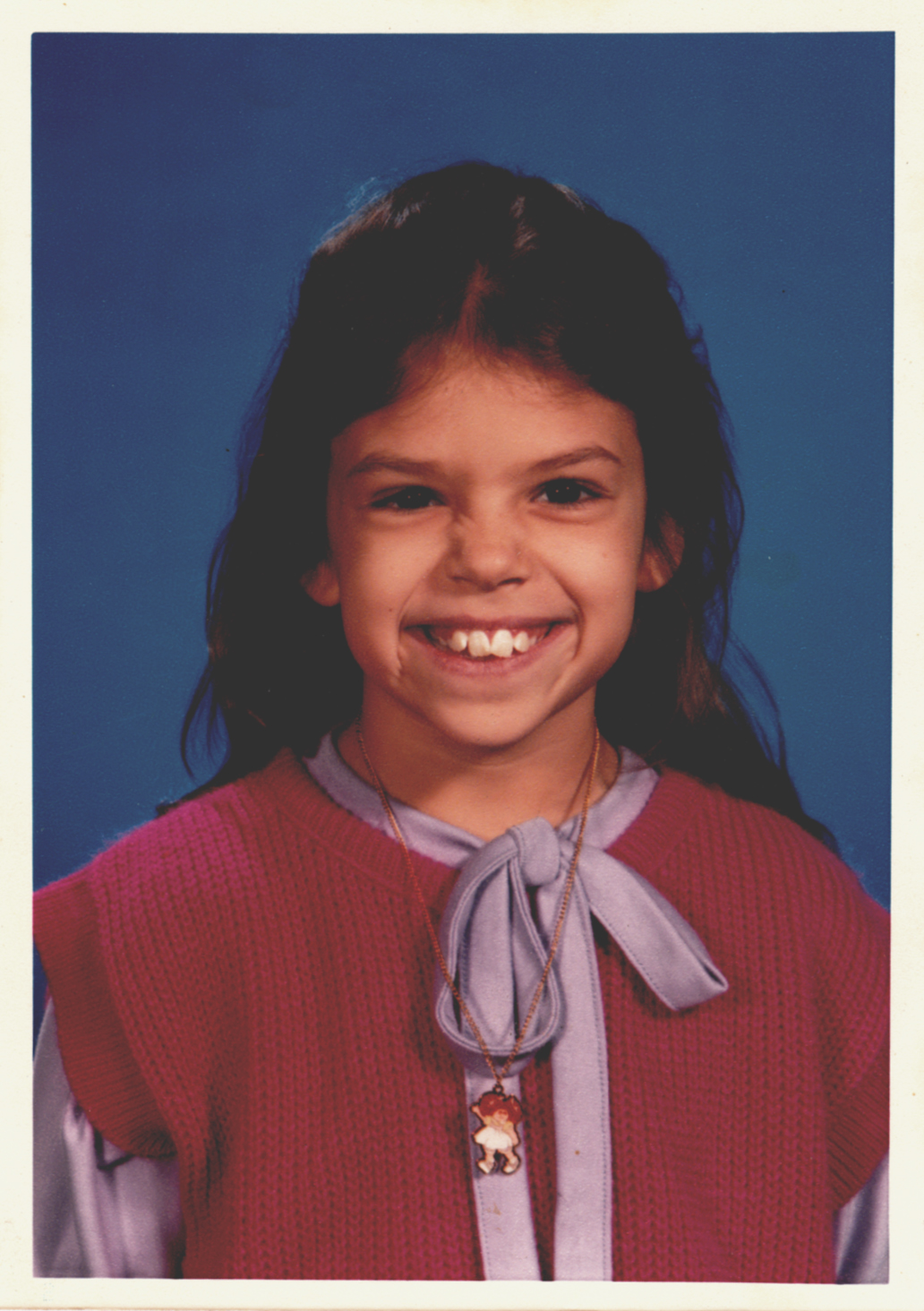
There’s a difference between gender acceptance and gender ignorance. Why not just teach your kids they can be anything they want to be? My mom was great about giving my sister and me the freedom to express ourselves, letting us put together our own outfits and style our hair however we wanted — even when this resulted in years of very, very bad school pictures.

Life is tough enough these days. Being a baby should be easy and fun, and free from serious questions about gender, sexuality and stereotypes. I commend these parents for creating an environment where their kids are accepted for whoever they are. But kids aren’t supposed to make all their own decisions.

Parents should say no when their kids want to play in the street or drink Drano. They’re supposed to encourage a vegetable here and there and teach their child how to respond when someone has a problem with him wearing a princess dress.

I hope this little bean inside me has his or her father’s confidence to disregard societal conventions. For my part, I’ll try to teach this baby that whatever he or she wants to wear, study, play or be is okay. That’s the plan anyway.